Showing posts with label Ben Loory. Show all posts

Friday, September 13, 2013

Books That I Keep Coming Back To For My Reasons

I reread. I don't reread a lot by the standard of some friends of mine, but I reread. There are certain books whose shear force is too much not to return to over and over again. Certain stories within certain books that I cannot forget about and have to keep reading and thinking about. So with that in mind, I thought, for once I'd like to compile them here, on the old blog, in all their glory. I have some things to say about each one, naturally. Take a gander, if you so choose. (Do take a gander at these books for yourselves, regardless of whether you care to read what I have to say about them.)


For as much as Slaughterhouse-Five and Catch-22 and Mark Twain and dozens of others of the recent or more distant past have had on my perspective about what fiction can do, George Saunders has in so many ways eclipsed them. Perhaps it's because I've had several wonderful encounters with Saunders over the years (not that we're friends by any means, though I can dream, can't I?), but there is such an earnestness to his work and his humor that adds to its potency. The man, himself, in my limited experience, seems to exude these characteristics as well. Though I'm only remarking on two of Saunders' books here, I could just easily include everything he's ever published. It's all very worthy of your time and attention. Rather, I'll let you investigate the entirety of his work yourself. I'll say a few things about the works of his that have resonated most powerfully, and which I return to most frequently. 

Allow me to begin with the one I consider more formative of the two: The Brief and Frightening Reign of Phil (Riverhead Trade, 2005). A marvel, truly. Few books have captured the attention of summer school students I've taught like this one has. Humorous, certainly, in all the bombastic and wondrously whimsical ways Saunders tends to be. Students identify with the plight of the Inner-Hornerites, their subjugation at the hands of the Outer-Hornerites and specifically a tyrannical, megalomaniacal jackass named Phil, whose cruelty and justification for his cruelty likewise are salient through the eyes of those he oppresses, and those sympathetic to the oppressed. We learn more about Phil than that, though. He's not merely a villain, to be sure. Phil's sad early life is given its due, is taken into consideration. It's not impossible to imagine that Hitler, too, could evoke our sympathy were we to more closely scrutinize his early life, his abusive father, his intense struggle with failure creatively. But like Hitler and the great many other despots who've come and gone in time, Phil is judged ultimately and quite reasonably by his most significant actions -- which is, indeed, a lesson for us all.  


Of all of my favorite Saunders short stories, and there are many, I think more than half are contained within the pages of CivilWarLand in Bad Decline (Vintage, 1997). In fact, the only ones not included in this collection that I can definitely say I'd immediately miss are, "Sea Oak," "Escape from Spiderhead," and "The Tenth of December." The titular story in CivilWarLand, meanwhile, is really spectacular. I can't lie, I find myself constantly overly influenced by CivilWarLand and "CivilWarLand in Bad Decline," in particular. A lot of things I've written in the past five years got their start merely from wondering WHY can't I write a short story as good as "CivilWarLand in Bad Decline"? I've tried. I'm not George Saunders. Can't be him. Happy with who I am, at last, as a writer. BUT I am thankful there is a George Saunders out there who continues to write disjointed tales in his beautifully idiosyncratic way. The melange of atrophic capitalistic dreams and nightmares fills his pages. Stories rife with the human toll society often takes, as we search hopefully to succeed at the kind of gain this country, at least, suggests is our one monomaniacal purpose on earth. Saunders looks at those who fall between the cracks, live on the margins, don't always get to see the light of day. We care about them because Saunders cares about them, teaches us that they are people, too. And there are more like them. And there's more to them, so much more, than we could possibly have expected at a superficial glance.


Don't Kiss Me (FSG, 2013) is a new classic, which I admit is a strange thing to call it seeing as it was only just released this past July. Lindsay Hunter is a writer you should expect to hear more and more from in the coming years. I was a fan of her work before I ever had the privilege of meeting her, and I was pleased that she's every bit as wonderful and kind and generous as I could hope she'd be. Her stories are amazing. I've heard people compare certain classic writers to her works and writing style, many of the southern tradition, and I would not disagree. Not exactly. BUT, where all that's concerned, I see Lindsay Hunter as a fascinating fusion of Southern and Midwestern traditions. It's no coincidence, I think, that Don't Kiss Me was dedicated to Chicago. She understands certain notions that cross the complexly different and similar sociological patterns of the two cultures. Much as Middle America can look and maybe even feel the same to the outsider, to the East and West Coasters, it really couldn't be more philosophically disparate. And in her fiction, Lindsay Hunter often creates emotional collages of these often contradictory elements. Stories like "After" bring this notion immediately into focus. Certainly, with the ostensible rural dialect of her first-person narrator, you could attribute this story to anyplace outside the urban and suburban sprawl in the post-apocalyptic United States. Anywhere troubles abound, which Lindsay Hunter recognizes seems to be everywhere. It's fun. It's the most fun you'll have in a society of ruin. Lots of gross descriptions loaded with black comedy. Bodies that are literally falling apart. Lindsay Hunter's work tends to walk the tightrope between what could happen and what is surreal. It's a delicate balancing act, but she has a way of making the improbable seem possible and the everyday seem spectacular. It's enviable and I hate her for it. But I get to read her stories, so in the end, I'd say I probably don't actually hate her for it / am happy she's out there, writing. She has a novel in the works. I consider that a very good thing.


As much as I'm thrilled Amelia Gray moved right into prime time with the release of THREATS (FSG, 2012), I'm certain to remain a devotee of Museum of the Weird (Fc2, 2010). With a title like that, how could it not be my favorite of her books? I ask you! And it's truly a museum of the weird. Stories like "Dinner" -- which I've taught to my high school students, and they typically enjoy puzzling over its disgusting dilemma: a woman must decide whether or not to eat a plate of hair. It's perfect for that age, too, because it asks them to reflect upon the possibility of pressure from a peer or more specifically a possible romantic interest and decide how far they'd be willing to go to prove their devotion. (I've yet to meet a student who would eat the hair in that situation, although they have said they'd do it for a lot of money.) There's also the killer who calls himself "God" and removes two ribs from men's rib-cages. 

Amelia Gray has such a gentle style of prose, casual and really pleasant to ease into reading. It is always fun to watch how it reveals her often disturbing or at least irreverent narrative turns. It creates a fantastic amount of tension, too. I suppose I'd liken it to the greats of the past. She brings to mind the matter-of-factness despite its twilight zone subject matter of writers like Shirley Jackson, Roald Dahl and, yes, George Saunders. She's great at picking out minutiae to have her characters obsess over, too, like a bag of frozen tilapia, a human tongue for possible ingestion or the hostage negotiating skills of javelina. Prepare yourself and enjoy. 


Stories for Nighttime and Some for the Day (Penguin Books, 2011). I've reread this book a couple times now. It's really a wonder of spare prose and fabulism. Loory is so subtle, so precise with his strangeness. I heard him explain to Brad Listi on the Other People Podcast that he has certain, if I'm not totally bungling this, mathematical methods for determining some of the plot turns and whatnot. That just sounds cool to me. And it works, if that's actually what he does. It works well. His stories are mazes of ambiguity, reminding me of Kafka in some respects but really are something entirely new. Fiction that's all his own. And the darkness that floats through his work is so appealing. Even in stories with "happy endings" we get this sense as readers that the other shoe is soon to drop. Things can be very grim, especially in the world of fiction. It's why we keep reading. We want to see things. Loory wants to tell you things. His characters are meant to experience things. Certainly he develops a sense of who they are, these characters, at their core. But he's more interested in how the nameless will respond in any given situation, at least that's been my takeaway. It's why almost no character in any of the stories, certainly no main character, is referred to as anything other than "the man" or "the woman." You don't need to know. Judge them by their actions, or their paltry little circumstances, as Nietzsche might refer to them.


HONORABLE MENTIONS: Adam Levin's Hot Pink, Mathias Svalina's I Am a Very Productive Entrepreneur, and Patrick Somerville's The Universe in Miniature in Miniature.

Wednesday, September 21, 2011

Time for "Stories for Nighttime and Some for the Day"

"Stories for Nighttime and Some for the Day" is hands down, my favorite book of the year (and not likely to be supplanted). (Although I've enjoyed several others immensely: "Normally Special," "Amazing Adult Fantasy," "You Can Make Him Like You," and still need to read or finish reading several more, "Freight," "Giant Slugs" and "The Pale King"). (One dark horse candidate I've got many praising things to say about and I shall hopefully get to in the coming weeks is a poetry chapbook called "Piano Rats," which will be released by Curbside Splendor next month.)

But Loory's collection, returning to the subject at hand, is not only my favorite book of this year, but easily among my favorite books all time. That's to start with.

I've been avidly following Ben Loory's fiction for awhile now, since his story "The TV" appeared in The New Yorker (appears in greater length in "Stories for Nighttime") in spring 2010, I think (i.e. I think it was spring of that year that it appeared). It's hard not to be captivated in some way by how artfully he succeeds at expressing grand sprawling ideas and sentiments in austere, general terms. (For example, see just there? how I wrote "grandiosity" and "austere"? He would have succeeded at saying the same thing but artfully and with much more exact diction). And I should say, these terms seem austere and general but bloom very quickly into something greater, abstractly significant.

His collection is at times moving, challenging, detaching, philosophical, mythical, and downright funny. Loory is a master at saying just enough, enough to keep you scratching your head in wonderment, and plenty of just enough to allow room for your own personal interpretation. Like Raymond Carver, he's an author whose narrative vacancies have as much -- if not more -- meaning than the passages themselves. This isn't a matter of showing and not telling, or some old cliche about writing. Loory seems possessed by all the good muses that power fantastical fiction. His writing forces you to read and parse an enigma, which is both possible and impossible to solve. (See what I mean, yet?)

In my mind, this collection catapults him (via trebuchet, an ostensibly more powerful engine than the catapult) into the ranks of contemporaries like George Saunders, Amelia Gray, and Ludmilla Petrushevskaya. It also puts him among classic authors like Franz Kafka, Daniil Kharms, and Donald Barthelme. All of which of is to say, Ben Loory is easily among my favorite authors, both living and dead. (Not to be morbid, right, but folks often make a distinction, in those exact terms, between the two -- the contemporary and the classic? Or am I just morbid? I suppose I could have put it as contemporary and classic but, ah, that becomes an issue of semantics I refuse to digress into...)

Let me see if I can explain why high praise such as lumping him in the category of the many venerable names above is both correct and due.

See first, in my opinion, the story "The Magic Pig." This story is astounding. Turns notions of belief and skepticism and outright disbelief on their respective heads. A kind of potent farce in the appearance of a magical pig, which shows itself at the inducement of a father who is belittling his daughter's new found faith. The father tells his daughter if god is real then a sign should manifest itself, and so immediately comes the pig, delivered ostensibly down from heaven. This is not enough for the father, who absconds with the pig and demands it show him another sign. I won't explain where the story goes from here. (It's short and fun to read, so read it.)

But I will say there is something of the history of faith and belief in the story, a kind of allegory in the man's conduct. So much of what we believe in contemporary religion (even respecting newer ones like Scientology) owe their roots to tales of ancient supernatural happenings. Things that historical record has no way of confirming absolutely and which require faith. One imagines even those so-called miracles, at the time of their occurrence, might have looked different to different witnesses, if they even ever truly occurred at all. (Bear in mind, it is very likely George Washington never, in his youth, cut down a cherry tree.)

Skeptics were probably eager for more, wishing to see more, and you can imagine a deity of the variety believed in by Western cultures would have grown tired of showing itself at every beck and call, knowing its creation could never be sated. That skeptics might never be able to believe enough for their own or anyone's liking. That such search for belief could easily become an obsession, and that obsession would only grow more potent and powerful with time and age, and the succession of each new generation, further set apart from the miracle's origin. And maybe that's not the point of life, searching for the truth of faith. Maybe, Loory seems to say, you'll find out when you die.

Choosing favorites pieces in "Stories for Nighttime and Some for the Day" is like choosing favorite chocolates from a boxed assortment that contains none with pie-like cherry filling -- they're all so very, very good and tasty. But given no other alternative my tops of the collection are certainly the above delved into "The Magic Pig" and "The Book," "The Crown," "The Octopus," "Death and the Fruits of the Tree," "The Shield," "UFOl A Love Story" (Easily the most emotionally charged among the rest), "The Graveyard," and "Hadley." Plus, "The TV' -- which is no doubt the most enigmatic and challenging of the collection.

"Hadley," though, I'll speak a few words of and then I'll stop with this review. "Hadley" was in the best sense "Weekend at Bernie's" meets "The Shawshank Redemption." Hadley comes up missing in an evening bed count at an unnamed prison and the guards, not wanting to take blame for his disappearance, invent a new Hadley (who is, I think significantly, one of the few characters in this collection who has a proper noun for a name). What ensues is startlingly profound, given the superficially farcical circumstances of the narrative. Which is something I think you as a reader will greatly enjoy. I certainly did.

So go get "Stories for Nighttime and Some for the Day" if you haven't already. It's one of those decisions I have faith you won't regret.

Monday, May 31, 2010

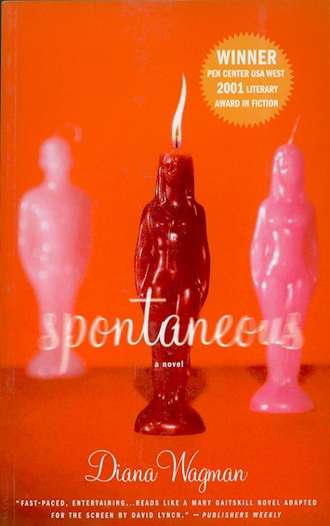
"Spontaneous" Not Quite What I Expected At All

Of novels dealing with really very perverse perversity, Diana Wagman's is right up there with "Lolita" in terms of being extremely graphic and uncomfortably titillating. I explain what precisely is meant by "uncomfortably titillating" in my "Lolita" review from last December (if you're at all curious about that, which of course who wouldn't be?). There's also some big to-do about spontaneous combustion, and so partially explains the title. You might say this book gets hot, Hot, HOT -- in a sense. Because in a sense it does, several senses even.

I don't especially want to reveal which specific sort of perversity makes "Spontaneous" such an unusual novel, one that drew me in more than I would expect, too. And I would go so far as to put said perversity up there with Humbert Humbert's pedophilia. I think it's the same potent taboo that can cause one to cringe. Yes, Wagman pushes the envelope somewhat, but it works. It works surprisingly well.

And it begins with a bang -- Auntie Ned's. Culminating with the pronunciation, "Her hands clawed and scratched for the past. Remembering. Remembering. She was not sorry. Not sorry. Her heart detonated, a final shuddering explosion of surrender." Auntie Ned's demise sets a number of tones right from the start. Take for example that spontaneous combustion is a useful phenomenon for expressing the urgency of passion -- and it's passion, then, that informs the reader of all he or she needs to be aware of if he or she is to appreciate and find plausible the perversity to follow.

Two sisters, Amy and Gwendolyn Clark, take up residence in Auntie Ned's home immediately following her death, which is for a variety reasons is not verified as a case of spontaneous combustion. It is Amy's belief that this is what has happened, but Gwendolyn is skeptical. The pair of sisters are not blood relatives of Auntie Ned but instead the daughters of her close friend. They subsequently grew close to Ned and, accordingly, she bequeathed her home to them upon her death.

The sisters are described as opposites in obvious physical ways (both are beautiful but oppositely beautiful) and less obvious ways like temperament. Perversity, meanwhile, is only partly sexual in "Spontaneous." The other component of perversity is shown to be how people are willing to abuse and be abused, perhaps because sweet dreams are made of these eventualities.

Amy brings into the sisters' lives a well-meaning -- if not particularly intelligent -- carpenter with a dark past named Roosevelt. She does so ostensibly with the intention that he will correct the structural damage done to Auntie Ned's home after the accident, but she has another ulterior motivation that reveals itself later. Amy possesses a dominating, overbearing personality -- going so far as being the quintessence of Nietzsche's Will to Power. She imposes herself on her sister and others both actively and passively, manipulating circumstances with the ease of an omnipotent. But her ego is also her downfall. She is convinced she's the only one who knows the score, and this proves to be a fatal error.

As the pieces began to fall into place I felt myself tearing right along with the narrative at what felt like a breakneck pace. I just felt myself wanting answers, some of which were given and some of which were left to inference -- Wagman striking a nice balance in between. There were numerous auxiliary characters, though none more important than Dr. Gustave Minor.

He is Professor of Pyrophenomena at the Pittsburgh Center for the Study of the Paranormal, stating his name with the highfalutin and overwrought title attached, in introduction. A literal little person, Dr. Minor is also highly manipulative and likewise eager to advance his career with a teleological ethic, which in turn manifests itself in the unscrupulous tack he's willing to use to prove the existence of spontaneous combustion. Spontaneous combustion is his white whale, to be sure. It is a phenomenon he is certain exists but has never been able to prove because for whatever reason it has never been witnessed. Amy, he believes, may provide a solution to that problem with the horrifying conclusion he reveals to her, a conclusion that puts lives at stake. Sweet and decent lives.

It's awesome and good, as I see it. It's an ending you'll find you want to arrive at, for what it may prove or disprove but also for catharsis, because I believe ultimately that's a big part of what spontaneous combustion is, for both its victims and their next of kin. A great big fiery relief.


Other Literary Items:

I've read a few enjoyable short stories, which struck a chord with me, recently from various random online lit zines and that I thought I'd share them with the rest of the world via Internet. Here they are:

At Prick of the Spindle it's "Enough" by Rebecca Cross

At NANO Fiction it's "Self Starter" by Sophie Rosenblum

At DOGZPLOT it's "The Pig" by Ben Loory (whom I'm becoming a very big fan of, especially after really enjoying his recent New Yorker short story, "The TV")

And lastly, at Jersey Devil Press it's "The Old Man and the Shark" by Tara King

READ THEM ALL . . . IF YOU DARE!!!! (or read whichever strike your fancy, if any do (which they should))